Changing Minds, Changing Fields
Manjhalwara village in the Kabrai development block of Mahoba district has long depended on traditional, rainfed agriculture. With limited irrigation facilities and erratic rainfall, farmers cultivated only Kharif and Rabi crops, earning less than ₹10,000 per acre annually. Even the 10–15 families engaged in vegetable cultivation saw little return, as traditional practices led to poor yields and high input costs. For most farmers, agriculture had become a low-return and high-risk activity.
The village has a population of 1,593 across 306 families, with nearly 36 per cent belonging to Scheduled Castes. Persistent water scarcity and lack of technical knowledge reinforced a cycle of low productivity and limited income opportunities.
This began to change when Gramonnati Sansthan introduced training on vegetable cultivation using the System of Crop Intensification (SCI) method for members of the local farmers’ group. The training focused on scientific spacing, improved soil management, reduced input dependency, and efficient water use—practices well suited to Bundelkhand’s dry conditions.
Motivated by the training, farmer Khalak Singh experimented with tomato and onion cultivation using the SCI method. On just 2 decimals of land, he invested ₹1,589 and earned a net income of ₹6,811. Earlier, under traditional practices, he invested nearly ₹2,000 on the same land and still incurred a loss. The results clearly demonstrated that improved methods could turn losses into profits.
The SCI approach also proved effective in reducing risks associated with water scarcity and climate stress. At scale, tomato cultivation through SCI can generate a net income of ₹3,20,550 per acre, or nearly ₹28,000 per month, offering a viable livelihood option for small and marginal farmers.
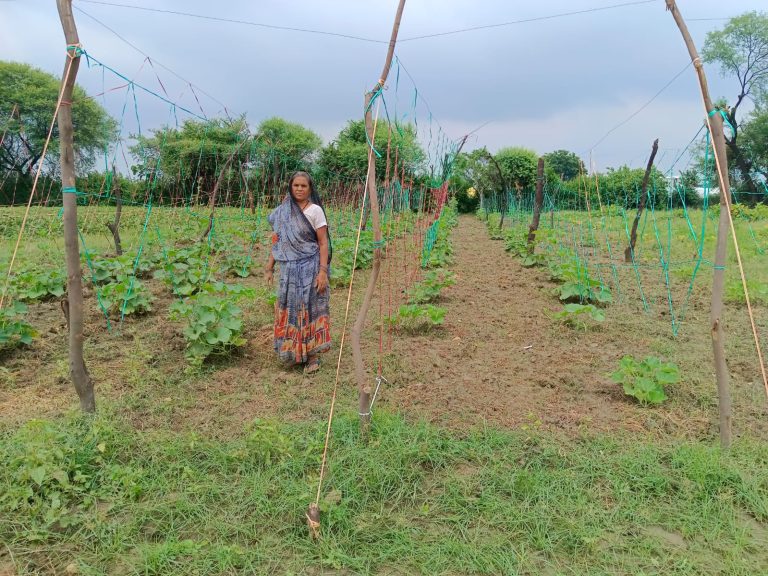
Khalak Singh’s success became a turning point for the village. Encouraged by visible results, 84 farmers adopted vegetable cultivation during the Zaid season, growing brinjal and ladyfinger using the SCI method. Additionally, 15 farmers began cultivating bottle gourd and sponge gourd (taroi) through the scaffolding method.
Today, average annual family income has increased by approximately ₹42,000. More importantly, farmers’ attitudes towards agriculture have shifted. Farming is no longer seen as an unavoidable struggle, but as a productive and reliable livelihood when supported by appropriate knowledge and techniques.
The experience of Manjhalwara shows how changing farming practices can change mindsets—transforming fields into spaces of opportunity and hope.